
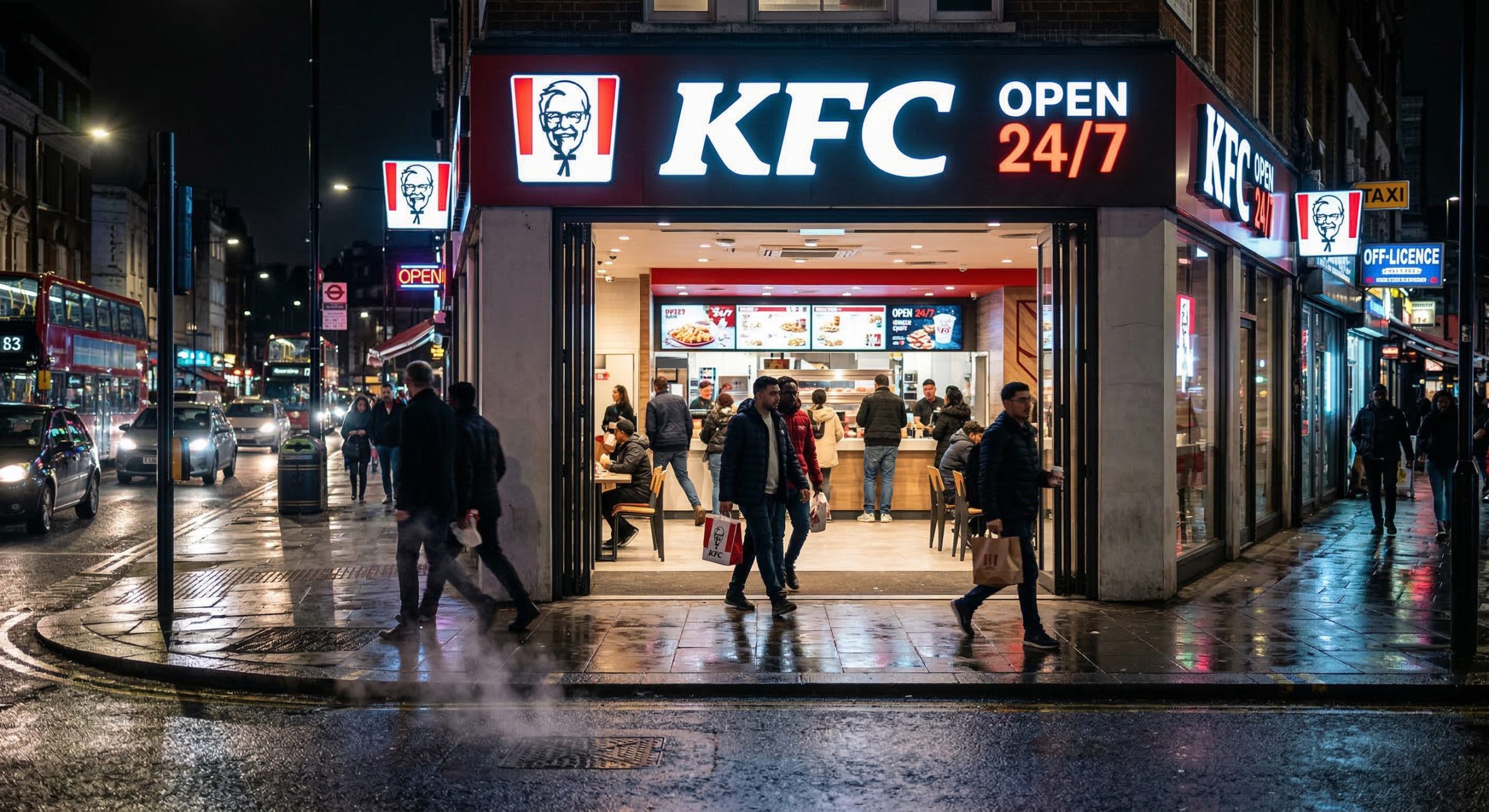
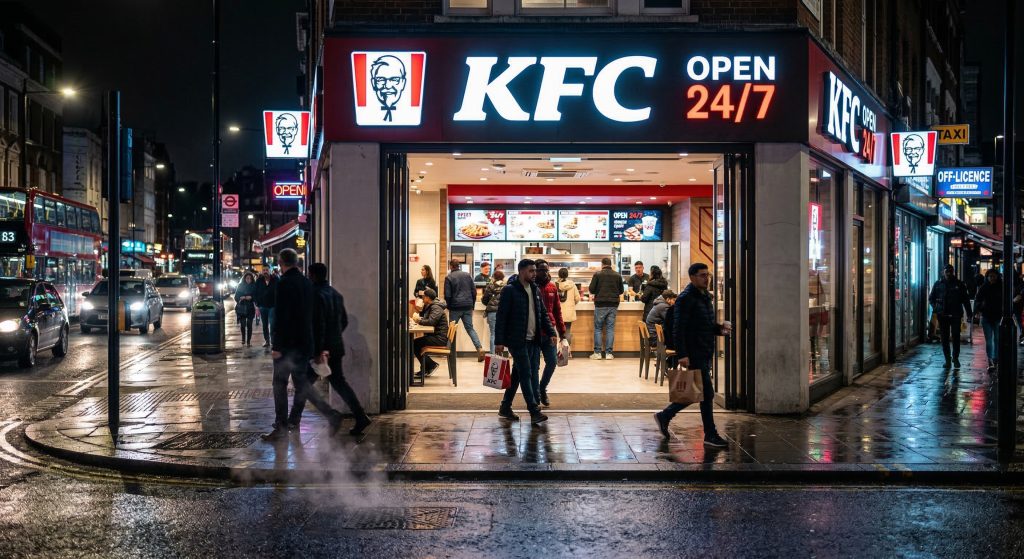
KFC’s decision to remove the doors from select restaurants is less a publicity stunt and more a carefully calculated statement about how modern brands communicate availability in an era where attention is scarce and competition is relentless. The idea itself is deceptively simple: if a restaurant is truly open around the clock, why keep the most symbolic object of closure? Doors, after all, represent the boundary between open and closed, inside and outside, welcome and restriction. By physically removing them, KFC transforms a functional architectural feature into a conceptual message. The restaurant does not simply claim to be open 24/7 — it embodies that promise through its very design.
For decades, businesses have relied on signage, lights, and marketing slogans to communicate operating hours. Neon “OPEN” signs glow in windows, printed schedules hang on doors, and websites promise late-night service. Yet these signals still rely on customers noticing and trusting them. KFC’s approach flips this logic entirely. Instead of telling people they are open, the brand makes it visually impossible to miss. When passersby see a restaurant entrance with no doors at all, the message becomes instantly clear: this place never closes.
The strategy also taps into the psychology of curiosity and surprise. In a world saturated with advertisements, consumers have learned to ignore traditional marketing cues. Billboards, banners, and social media ads often blend into the background noise of daily life. But something unexpected in the physical environment — like a restaurant without doors — disrupts that pattern. People stop, take photos, and share the moment online. The design becomes a conversation starter, turning architecture itself into a viral marketing tool.
There is also a deeper symbolic layer behind the idea. Doors historically represent control over access: they can be opened, closed, locked, or guarded. Removing them signals a radical form of openness. It suggests that the brand is welcoming customers at any moment, day or night, without barriers. In this way, the design reflects a broader trend in modern retail and hospitality, where convenience and constant availability are becoming central expectations.
Of course, the move is not purely philosophical. It is also a practical marketing strategy designed for the age of social media. A doorless restaurant is inherently photogenic and unusual, making it perfect for spontaneous posts and viral content. Every person who snaps a picture or shares a video effectively becomes part of the campaign. Instead of investing solely in traditional advertising, the brand leverages the curiosity of the public to amplify its message organically.
Ultimately, KFC’s doorless restaurants demonstrate how modern branding increasingly blurs the line between architecture, marketing, and storytelling. The building itself becomes the advertisement. Rather than relying on words to explain its promise of constant service, the restaurant shows it through design. In doing so, KFC proves that sometimes the most powerful marketing message is not something you read — it’s something you experience the moment you walk in.