
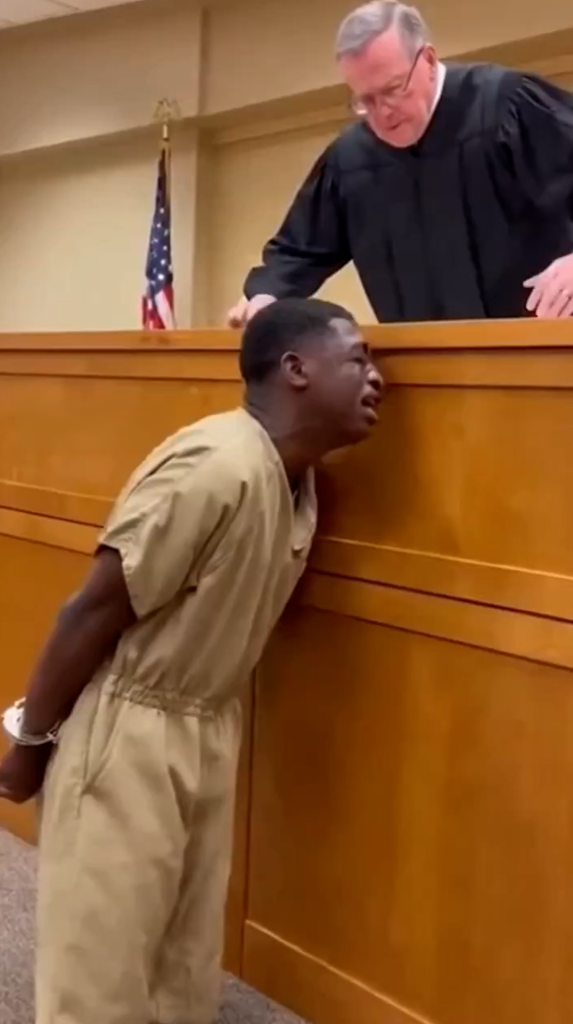
In courtrooms around the world, there are moments that change lives forever. Some are quiet, almost procedural. Others are raw, emotional, and impossible to forget. One such moment unfolded when Taquon Mitchell stood before a judge, waiting to hear his fate. What followed was a powerful scene that captured the harsh reality of justice—and the human emotion that comes with it.
Mitchell had been convicted in connection with a deadly armed robbery that ended in tragedy. The case had already drawn attention due to the seriousness of the crime, but nothing could have prepared those in the courtroom for what would happen during sentencing. As the proceedings began, the atmosphere was tense. Family members of the victim sat quietly, carrying the weight of their loss. Mitchell himself appeared nervous, aware that the next few minutes would define the rest of his life.
Before the judge delivered the final sentence, Mitchell was given the opportunity to speak. In a moment that seemed filled with regret, he addressed the victim’s family. His voice reportedly trembled as he apologized for his actions. Whether the apology was seen as sincere or not, it did little to ease the pain in the room. For the victim’s loved ones, no words could undo what had been done.
Then came the moment everyone had been waiting for.
The judge, maintaining a composed and formal tone, announced the sentence: life in prison.
Almost instantly, the emotional weight of those words became visible. Mitchell, who had been standing still just seconds before, began to break down. He wiped tears from his face, struggling to hold himself together as the reality of his situation set in. The courtroom, already heavy with tension, grew even more silent. It was no longer just a legal proceeding—it was a human moment, raw and unfiltered.
For many observers, this was the moment that stood out the most. The shift from anticipation to realization was immediate. One second, there was still uncertainty—some distant possibility of a different outcome. The next, that possibility was gone forever. Life in prison is not just a sentence; it is a final chapter written in a matter of seconds.
Cases like this often spark debate. Some people focus on the crime itself, emphasizing the need for justice and accountability. Others look at the emotional reaction of the defendant and reflect on the human side of these situations. Seeing someone break down in court can be unsettling, even when the crime is serious. It forces people to confront the reality that behind every case is a person, a family, and a story that has led to this moment.
At the same time, it is important not to lose sight of the victim. While Mitchell’s reaction drew attention, the pain experienced by the victim’s family is permanent. For them, the courtroom is not just a place of justice—it is a reminder of loss. The life sentence may bring a sense of closure, but it cannot replace what was taken from them.
This duality is what makes courtroom moments like this so powerful. On one side, there is justice being carried out. On the other, there is emotion—grief, regret, anger, and sometimes even disbelief. It is a collision of law and humanity that leaves a lasting impression on everyone involved.
In recent years, videos and reports of emotional courtroom reactions have gained traction online. They resonate with audiences because they are real. There is no script, no acting—just genuine reactions in life-altering moments. Mitchell’s case is one of many that highlight how quickly everything can change. A single decision, a single action, can lead to consequences that last a lifetime.
As the courtroom emptied and the proceedings came to an end, one thing remained clear: the moment the sentence was delivered would not be forgotten. For Mitchell, it marked the beginning of a life behind bars. For the victim’s family, it was another step in a long journey of healing. And for those who witnessed it, it was a stark reminder of how serious—and final—the justice system can be.
In the end, this case is more than just a headline. It is a story about consequences, emotion, and the reality of facing the outcome of one’s actions. And in that quiet, heavy courtroom, when the words “life sentence” were spoken, everything changed in an instant.