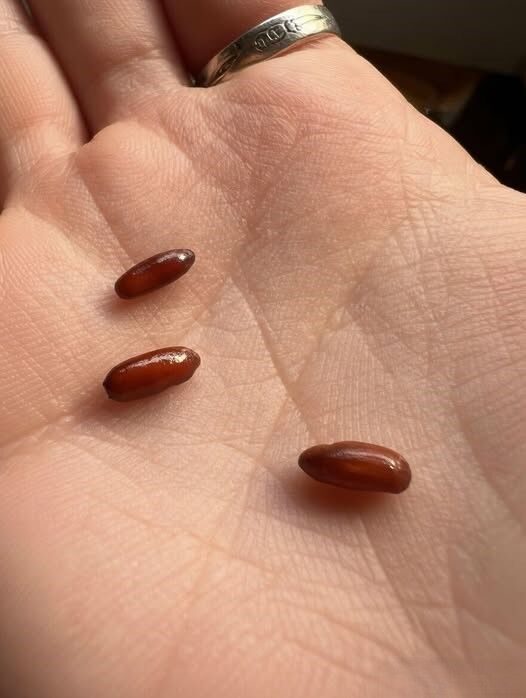
You walk into your bedroom expecting nothing unusual, just the usual sense of rest, routine, and familiarity. Then something small breaks that feeling. On the bed are three reddish-brown, shiny, capsule-shaped objects. They look oddly deliberate, almost as if they were placed there on purpose. In a moment like that, the mind reacts fast. Insects, contamination, something harmful. That response is not unreasonable. It is instinct.
Bedrooms feel personal and protected, so when something unfamiliar appears there, especially something that looks organic, the brain quickly shifts into alert mode. It is a natural response to uncertainty. When something is unknown, biological-looking, and clearly out of place, it is easy to assume danger before anything else. But in situations like this, the explanation is usually much simpler.
Based on their appearance, smooth, glossy, oval, and nearly identical, the most likely explanation is that they are softgel capsules. These are extremely common and often include supplements such as fish oil, vitamin E, or CoQ10. Their look matches almost perfectly: flexible texture, amber or reddish tone, and a uniform shape. Because they are quiet when they fall and do not break easily, they can drop from a bottle, a pocket, a nightstand, or a bag without being noticed, eventually ending up somewhere unexpected like a bed.
There are a few easy ways to check. Gently pressing one may show that it compresses slightly rather than feeling hard or brittle. A faint seam may also be visible along the edge. Looking nearby for supplement containers can provide another clue, and sometimes even a mild odor, such as fish oil, can help confirm what they are. In many cases, the answer is sitting somewhere nearby in plain sight.
Other possibilities are far less convincing. Seeds are usually harder and less uniform in shape. Insect eggs tend to be pale, clustered, textured, or attached to a surface rather than smooth, glossy, and neatly separated. Droppings are generally uneven, crumbly, or irregular in appearance. The polished and consistent look of these objects strongly suggests they are not biological remains or signs of infestation.
Even so, a few simple precautions still make sense. It is best not to consume them, even if they appear to be supplements. Cleaning the area and checking with other people in the home can help identify where they came from. If there is still uncertainty, keeping one sample and asking a pharmacist can provide a quick and reassuring answer.
The most important point is that something strange is not automatically something dangerous. The brain often fills in missing information with worst-case scenarios, especially in personal spaces where anything unfamiliar feels more intrusive. But most of the time, the explanation is ordinary. And once that explanation becomes clear, the fear usually fades just as quickly as it appeared.